
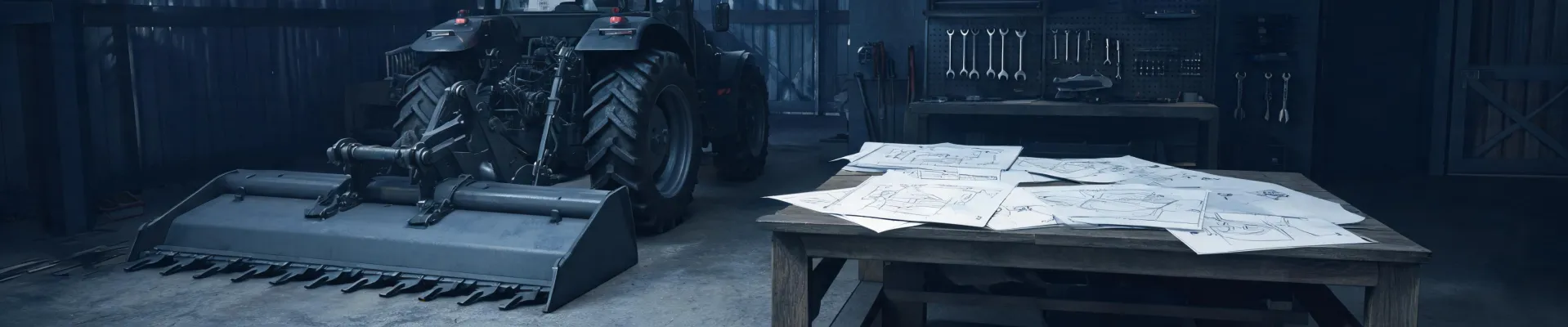
For a tractor attachment you will use only a few times a season, renting or custom hiring is usually the better first move than buying. The exception runs the other way: an attachment sitting on the critical path, where a missing tool stops harvest or stalls bale handling, can justify ownership even at low hours, because what you are buying then is schedule control rather than machine utilization.
Everything below assumes a small US vegetable or hay operation running a compact tractor. Fit questions get model-specific only where a model is named, such as a B2301, B2601 or 1025R. Mounting, hydraulic and lift details belong to the individual tractor and the individual attachment, so treat any compatibility claim as something to confirm against that model's own information before money changes hands.
How Often Will You Really Use It?
Start with a count, not a price. How many times in one season will this attachment actually be on the tractor? Be specific rather than optimistic: a bed shaper or rototiller might see two passes at planting and one cultivation in a vegetable rotation, while a bale spear or grapple might work a few weeks of hauling and then sit untouched. Write the number down as a range and budget against the low end, because the low end is what a wet spring or a short harvest window will actually deliver.
That count forces the next question. Is the task rare, or is it a bottleneck? A rare task can be batched, deferred, shared with a neighbor who already owns the implement, or compressed into one long day with rented equipment. A bottleneck holds up everything behind it — beds that cannot be formed, bales that cannot be moved before rain — and the cost of delay there is not measured in machine hours.
Renting or custom hiring such implements or machines is often a better choice than trying to keep old equipment in operating condition, and the same reasoning applies before you buy rather than after. A low-use implement carries its cost in shed space and attention every idle month, and that burden lands on the hours it actually works.
There is a second-order question buried in that count. If the job is rare now, will it still be rare in three years? A grower adding hay ground or another block of beds can turn a twice-a-season tool into a weekly one, and that shift is what should move an attachment from the rental column into the buy column — not the fact that you used it twice last year.
Suppose a vegetable operation with a dozen beds and a small hay field is looking at a three-point rototiller. Two spring passes and one fall pass is a realistic year for that machine, and the same tractor could handle a rented tiller in a single weekend. Now suppose the same farm is reseeding successions every ten days from April to August. Same implement, same tractor, completely different answer, and the only thing that changed was the count.
What Does Ownership Cost After Purchase?
If the attachment clears the frequency test, the purchase price turns out to be the smallest line in the ledger. Ownership costs for machinery and equipment include depreciation, interest on investment, taxes, insurance, and housing, and all of them apply to a machine that spends most of the year under a tarp.
Depreciation is the quiet one. A new implement loses value the moment it leaves the lot and keeps losing it whether or not it works. A used one has already taken the steep part of that drop, which is exactly why used prices look so attractive on low-hour tools — and why the resale value of what you buy today is part of what you are paying today. Interest is real money even with no loan in sight, because capital tied up in an idle implement cannot buy seed, fuel or another irrigation line.
Taxes and insurance follow whatever equipment schedule your operation carries, and they do not pause for a machine that only works in October. Housing is the square footage you give up in a shed that is already too full in February, plus the price of keeping that space dry enough that the implement is not rusting in place between uses.
What is one season of use actually costing you? Divide the ownership burden by the realistic seasonal count from the first test, then set that against the rental rate plus the hours spent hauling and returning. Rental rates are visible and ownership costs are not, which is why the comparison so often gets skipped and so often gets it wrong.
The sticker price also hides what the implement drags in behind it: a mounting frame, an extra hydraulic circuit, a ballast box, a set of pins that never quite match what is on the tractor. None of that appears in the advertised number, and all of it lands in the same budget line.
Who Will Keep It Running?
Preventive maintenance is time and money well spent, which raises the obvious follow-up: who is going to spend it? On a two-person vegetable farm in June, the honest answer is usually nobody, and that is where a low-price buy can turn into a headache.
Maintenance burden is more than grease and oil. It is knowing the service intervals, keeping the manual where someone can actually find it, ordering the filter before the season instead of during it, and catching the cracked weld or the worn cutting edge before it becomes a repair in the middle of harvest week. A machine that lives outside and works only a few days a year is a machine whose real condition you discover at the worst possible moment, because nothing about it gets checked often enough to fail gradually in front of you.
So ask your own operation a direct question. If nobody owns this job in July, does ownership still make sense? Rental equipment arrives with someone else's maintenance department attached; you return it and the responsibility goes back with it. Ownership transfers that responsibility to whoever is standing closest when the implement quits.
That transfer is worth pricing honestly. A rented tiller that runs rough gets swapped at the counter. An owned tiller that runs rough becomes your Saturday, your parts order, and possibly a skipped cultivation pass. The labor question is not whether you can maintain an implement — most operators can — but whether that work fits into the weeks when the farm already has more jobs than hands.
Which Sourcing Route Fits This Season?
The candidate list is short and worth writing down before you call anyone: buy new, buy used, rent from a local yard, or custom hire the operator along with the machine. Each route carries a different mix of cash outlay, availability risk and support.
Buying new buys warranty and dealer attention, and it pays for that in depreciation. Buying used trades the warranty for a lower entry price and moves the inspection burden onto you, which matters most on implements with wear surfaces — augers, chains, gearboxes, cutting edges, anything that has been run hard by someone whose soil you have never seen. A used implement that needs a gearbox in year one can cost more than the new one you passed on.
Renting fits occasional, time-bound work and keeps capital free, and it puts the machine back in someone else's shed when the job ends. Custom hire fits work where the operator matters more than the iron, and it removes the storage question entirely. Both routes keep you dependent on local capacity, and that dependency has a season — the week every hay grower in the county wants the same baler is not the week to assume a rental is available.
Fit cuts across all four routes. An attachment that mounts cleanly to a B2601 is not automatically the right choice for a 1025R, and a quick-attach claim in a marketplace listing is not the same thing as a confirmed match for your tractor. Before comparing prices, confirm the specific attachment model against the specific tractor: mounting system, lift capacity, hydraulic flow and reach. A cheap implement that needs an adapter to work is not cheap.
Then ask which route answers this season rather than this decade. If the job is three weeks out and the implement is not on the farm, rental or custom hire is the only option that addresses the actual problem in front of you.
When Should You Rule Out Buying?
The exclusion test is cumulative, not a single score. If the seasonal count is low and the task can wait, buying fails before price enters. If storage is tight or the upkeep has no named owner, it fails again. Capital that would do more work elsewhere and parts support hours away are separate disqualifiers. One is usually enough; two settle it.
Renting or custom hiring is the recommendation for occasional, time-bound work. What you give up is availability — you are leaning on a local yard or a neighbor's schedule, and during a compressed hay window that lean is the real cost of the decision.
Buying earns its place under narrower conditions. The job has to be frequent enough to carry the ownership burden, critical enough that a missing implement costs more than the machine does, and backed by a maintenance plan someone will actually execute on a Tuesday in June. When all three hold, ownership stops being a luxury and becomes infrastructure.
The hard cases sit in the middle. A bale grapple used only a handful of times a season on a farm where bales must move the day they are made is not obviously a rental, because the failure mode is spoiled hay rather than a delayed chore. A plug aerator used on ground that could wait a week is not obviously a purchase. Sort each attachment separately, on its own count and its own delay cost, instead of applying one verdict to the whole tool list.
What Must You Check Before You Commit?
Before committing, pin the specifics down in writing. Which exact attachment model and which build range are you buying, and which named tractor is it confirmed to fit? What does the quote include — delivery, setup, mounting hardware, an extra hydraulic circuit — and what is deliberately excluded? On a rental, what are the terms on delivery, cleaning, damage and late return, and who pays for a hose that fails in the field?
Parts and service belong in the same list. Who stocks wear parts for that attachment, how long does an order take to arrive mid-season, and does the dealer offer service or only sales? Who performs the preventive maintenance the machine will need, and does that person have the manual? These are the questions that decide whether a good price stays a good price in year three.
Current model interfaces, quotes and after-sales terms are not settled here because they vary by dealer, by model year and by season. They are also the numbers that decide the purchase, so get them from the dealer or the rental yard directly, for your tractor and your attachment, before anything is signed.
Ownership is the right answer only when the calendar, not the checkbook, is the binding constraint: the implement is there when the window opens, and no one else's booking decides your harvest day. What you accept is an ownership burden that never appears on the sticker and an upkeep job that must belong to someone. Renting or custom hiring protects cash and shed space and pushes maintenance onto the other party, but it gives up spontaneity and hands your timing to local availability. Choose the one whose downside you can live with in your worst week, not your average one.
